Author: Mia

Someone once told me that a man will not cheat on a good woman—and for a while, I believed that.

Not because I fully agreed with it, but because it gave me something to hold onto. Something that explained why it happened.

Because when I got cheated on, I took it personally.

I didn’t just feel hurt—I questioned myself. I started wondering if I wasn’t enough, or if I missed something, or if there was a version of me that would have prevented it.

And the situation itself didn’t make it easier to process.

He wasn’t sending explicit pictures to someone random—he was sending them to his ex.

Someone who was supposed to be in the past. Someone I thought was already a closed chapter.

So it wasn’t just cheating—it was realizing that something I believed was safe… wasn’t.

That didn’t stay in that relationship.

It followed me into the next one.

Before that, I never had an issue with exes. I understood that sometimes people are better off as friends. That never felt threatening to me.

After that experience—it did.

So when I got into another relationship, one of our first arguments was about that. About him being friends with his ex.

And I remember trying to explain it—this isn’t random, this is based on something I already went through.

But he didn’t really understand that.

And honestly, that makes sense. If you haven’t experienced it, it probably feels like an overreaction.

At the time, I told myself it was a boundary.

Looking back—it was fear.

I thought if I could control certain things—limit certain situations—I could prevent that kind of betrayal from happening again.

But that only works if the problem is the situation.

It’s not.

Because someone who lacks integrity doesn’t need the “right” setup to cross a line.

They’ll do it anyway.

And what really changed things for me was what happened later.

He got into another relationship and described it as perfect—easy, healthy, everything mine wasn’t.

And for a moment, that kind of makes you question yourself again.

Like maybe it really was you.

But then—

He did the same thing to her.

Same behavior. Same patterns. Same lack of boundaries.

At one point, he even tried to cross that line with me again.

And that’s when it became clear.

It was never about me.

Because if someone can have what they call a “perfect” relationship and still cheat—then the issue isn’t the woman.

And it forced me to go back to something I ignored the first time.

There was a moment I should have walked away.

The first time he crossed a line—I felt it. I saw it.

But I stayed because he chose me.

And I thought that meant something.

But it doesn’t.

Because being chosen after the fact doesn’t erase what already happened.

If anything—it confirms it.

So now when I hear people say a man won’t cheat on a good woman—I don’t agree.

A good man won’t cheat.

And a man who cheats will cheat on anyone—good, perfect, easy, it doesn’t matter.

Because it was never about her.

The biggest thing I had to unlearn was the idea that I needed to control everything to feel safe.

That I needed to change how I show up—be stricter, more guarded—just to avoid being hurt again.

But that’s not where safety comes from.

It comes from the person you choose.

I don’t believe cheating reflects a woman’s worth.

I believe it reflects a man’s character.

And once I understood that—

I stopped carrying something that was never mine to hold.

Cheating isn’t a reflection of who you’re with—it’s a reflection of who you are.

Someone once told me that a man will not cheat on a good woman—and for a while, I believed that. Not because I fully agreed with it, but because it gave me something to hold onto. Something that explained why it happened. Because when I got cheated on, I took it personally. I didn’t just feel hurt—I questioned myself. I

I used to believe that if something felt real enoughit would last.

That if two people experienced something deep, something meaningful, something that made them feel seen in a way they hadn’t beforeit had to mean that it was worth holding onto.

That it could be rebuilt, even after it broke.

But I’ve come to realize that just because something was realdoesn’t mean it still exists in the same way.

And sometimes, the hardest part isn’t losing the relationship.

It’s realizing that what you’re holding ontoisn’t what’s actually there anymore.

There were parts of my relationship that were real. The connection, the conversations, the way we understood each other beneath the surface. That wasn’t imagined. It wasn’t one-sided.

But there were also parts that were unstable.

I wasn’t always honestand that truth is more layered than I wanted to admit at first.

When I first told him I was pregnant, I was in a completely different emotional place. I was scaredand a part of me was trying to hold onto him, trying to create something that would keep us connected.

And that wasn’t right either.

Because forcing a connectioneven through something that seriousdoesn’t come from love. It comes from fear.

But by the time everything settled, I had already gone through it on my own.

I had already made a decision that carried weightand sat with the aftermath of it by myself. The grief, the confusion, the emotional impact of itI didn’t share that with him. I processed it alone.

So when we reconnected later, I wasn’t in that same place anymore.

And that’s where things became even more complicated.

Because instead of telling him the truthI told him there was nothing to tell.

Not because it didn’t matterbut because to me, it had already happened. I had already lived through it. I didn’t see the point in reopening something that I had already worked so hard to get through.

I told myself I was protecting him.

That I was sparing him from pain, from guilt, from feeling tied to something he didn’t get the chance to process in real-time.

But if I’m being honestI was also protecting myself.

I didn’t want to reopen a wound that I had already carried alone.

And that was the biggest problem.

Because when I finally told him the truthI didn’t protect him from the pain.

If anything, it created more of it.

Because it wasn’t just about what happened.

It was about everything he didn’t get to experience in real-timeeverything he didn’t get to feel, process, or understand alongside me.

And in that moment, it wasn’t just the situation that was lost.

It was the trust.

And that partwas something I didn’t get to decide for him.

Trust doesn’t break all at once. It breaks in moments like thatwhere clarity turns into confusion, and certainty turns into doubt. Where someone starts to question not just what you’re saying, but what’s real.

And once that kind of trust is shaken, it changes the way someone shows up.

I saw that shift.

He became more distant, more guarded, more detached. And part of me understood why. But another part of me still wanted him to fight for the connection, to stay, to try to rebuild what had been broken.

But relationships don’t survive on one person wanting to repair them.

They require two people who are both willing to sit in discomfort, to be honest, to rebuild something that no longer feels safe.

And we weren’t there.

By the time we tried to find our way back to each other, we were no longer standing in the same place. There was too much history, too much confusion, too many moments that hadn’t been fully processed.

It became easier to disconnect than to rebuild.

And that’s the part that’s hardest to accept.

Because starting over with someone new is simpler. There’s no past to carry, no wounds to revisit, no trust to repair. But there’s also no depth yet. No understanding of who that person is when things get hard.

And yeteven knowing all of thatthe what-ifs don’t just disappear.

They show up in quiet moments.

In small reminders.

In memories of how it felt to be seen in a way that you didn’t even know you needed.

Because that’s the part that stays with me.

Not just the lovebut the way he saw me.

The way he made me feel like my depth wasn’t too much. Like the parts of me that felt complicated or intense weren’t something to hidebut something to understand.

And when someone sees you like thatyou want to keep that connection.

Not just romanticallybut in any way you can.

Because that part was real.

And I think that’s what makes letting go so difficult.

It’s not like losing someone to distance or time.

It’s knowing they still existthat they’re still out thereand choosing not to reach for them anyway.

It’s learning how to sit with the feeling without acting on it.

It’s learning how to create distanceeven when the connection still feels real.

And I think that’s the part no one really talks about.

It’s not just that love isn’t enough.

Because lovegives you hope.

It makes you believe that something can still grow, still shift, still become something more than what it is right now.

But hope only works when it’s shared.

And when you’re the only one holding onto that visionwhen you’re the only one trying to see what it could becomeyou’re not building something together anymore.

You’re holding onto something that no longer exists in the same way.

You’re chasing a version of it that lives in your mindnot in reality.

And that’s where it becomes dangerous.

Because it doesn’t feel delusional.

It feels realbecause at one point, it was.

That version of the connection existed.

That depth existed.

That feeling of being seen, understood, and met in a way you didn’t expectthat was real.

But what’s also realis that it’s not being held the same way anymore.

And no matter how much you want to bring it backyou can’t do that by yourself.

You can’t carry love for two people.

You can’t rebuild something that the other person has already let go ofor doesn’t have the capacity to hold anymore.

And no amount of love changes that.

And accepting that isn’t peaceful.

It doesn’t come with closure.

It comes with moments where you still feel itwhere it still crosses your mindwhere part of you still wants to reach for it.

But you don’t.

Because at some point, you realizeyou’re not holding onto a person anymore.

You’re holding onto a memory of who they were with you.

And learning to let go of thatis a different kind of heartbreak.

Sometimes you’re not missing the person… you’re missing the version of them that existed with you.

I used to believe that if something felt real enough—it would last. That if two people experienced something deep, something meaningful, something that made them feel seen in a way they hadn’t before—it had to mean that it was worth holding onto. That it could be rebuilt, even after it broke. But I’ve come to realize that just because something

For a long time, I struggled to understand how I could be so aware of my patterns in relationships and still feel completely overtaken by them in the moment. I wasn’t unaware. I knew when I was overthinking, when something didn’t fully make sense, and when my fears didn’t match reality. But that awareness didn’t stop anything.

Because for me, it was never really about the thoughts.

A lot of what we’re taught, especially in therapy models like CBT, is that our thoughts create our feelings, and then our feelings drive our actions. But that wasn’t my experience. If anything, it felt reversed.

It started with a feeling.

And once that feeling showed upespecially feareverything else followed.

There were moments where I didn’t even have time to think. The feeling would come first, and my body would immediately want relief from it. Not understanding. Not logic. Just relief.

And that’s where my behavior came from.

I didn’t ask questions because I didn’t know the answers. I asked because I needed to feel okay again. Reassurance wasn’t about changing my thoughtsit was about changing how I felt. The moment I heard what I needed to hear, the feeling would calm down. It was almost immediate.

Like a form of relief I couldn’t create on my own yet.

And because of that, I kept going back to it.

Looking back, the part that’s hardest to admit is that I wasn’t lacking love.

I was with someone who showed up. Someone consistent, reassuring, and emotionally available. He gave me love freelywithout me having to earn it, prove myself, or compete for it.

And that was something I didn’t know how to trust.

Because my entire understanding of love had been built on the idea that it had to be earned.

Growing up, love didn’t feel unconditional. It felt tied to achievement. It meant getting straight A’s. Getting into college. Earning scholarships. Being recognized. Doing everything right so that I could be seen as worthy.

That’s what love looked like to me.

So when I was finally in a relationship where someone chose me without requiring any of that, it didn’t feel secure. It felt unfamiliar. And because it felt unfamiliar, it felt temporary.

I believed that as easily as that love was given to me, it could just as easily be taken away.

I hadn’t earned itso how could I trust that it would stay?

That belief changed everything.

I didn’t just receive loveI questioned it. I needed reassurance repeatedly, not because I didn’t understand what was happening, but because I didn’t trust that it would continue. I would look for shifts in behavior, analyze small changes, and sometimes test the relationship without fully realizing that’s what I was doing.

Not because I wanted to push someone away, but because I needed to know if they would stay.

And in the beginning, they did.

They reassured me. They showed up. They tried to make me feel safe. But over time, something shifts. Reassurance turns into exhaustion, and patience turns into confusion. The same consistency that once felt grounding starts to feel like it’s not enough.

And eventually, the dynamic changes.

And when it does, it reinforces the belief that was there from the beginningthat they weren’t going to stay.

A self-fulfilling pattern.

Not because I wanted it to end, but because I never believed it would last.

This is something I’ve come to understand more deeply in the context of Borderline Personality Disorder, but it’s not exclusive to it. A lot of people experience this when they’re anxious in relationships. For me, having a disorganized attachment style meant I could fall on both sidessometimes needing closeness, sometimes pulling awaydepending on the situation and the person.

I’ve also been on the other side of this.

I’ve experienced what it feels like to be with someone who needs constant reassurance, and it can feel overwhelming. It can feel like nothing you do actually lands. And sometimes, that need for reassurance turns into controlnot because someone wants to control you, but because they’re trying to control the possibility of being hurt.

But instead of creating safety, it creates distance.

And that’s where accountability comes in.

Because while our reactions come from real experiences, they don’t always reflect the reality of the person in front of us. We’re often responding to something from our past, not something that is actually happening in the present.

Understanding that doesn’t excuse the behaviorbut it does explain it.

And explanation is what allows change.

For a long time, I lived in extremes. My emotions felt so intense in the moment that they would take priority over everything else. Not because I didn’t care about the other person, but because I hadn’t learned how to sit with those emotions without immediately trying to get rid of them.

That’s the difference for me now.

I’m not trying to eliminate the feeling.

I’m learning how to not act on it immediately.

Because relationships don’t create these patternsthey reveal them. The parts of us that feel reactive or overwhelmed were always there. They just didn’t show up until something triggered them.

And if we don’t take accountability for that, nothing changes. We repeat the same cycles with different people, often drawn to the same dynamics, until those patterns no longer feel familiar.

For me, that shift has meant redefining what love actually looks like.

I used to associate love with intensityemotional highs and lows, unpredictability, and the need to prove something. I thought peace meant something was missing.

Now I understand that peace is exactly what I was missing.

I don’t want to chase. I don’t want to question. I don’t want to feel like I have to prove that I’m worthy of being chosen.

I want consistency. I want effort that feels natural. I want to feel calm, not constantly activated.

And more than anything, I’m learning that I don’t have to prove that someone will stay.

I have to believe that I’m worthy of someone who does.

That doesn’t mean I’ve figured it all out. It just means I’m learning how to sit with uncertainty without trying to fix it immediately.

And for the first time, that feels like real change.

It was never about whether they would stay… it was about whether I believed I was worth staying for.

For a long time, I struggled to understand how I could be so aware of my patterns in relationships and still feel completely overtaken by them in the moment. I wasn’t unaware. I knew when I was overthinking, when something didn’t fully make sense, and when my fears didn’t match reality. But that awareness didn’t stop anything. Because for me,

I’ve been in so many different places when it comes to love. I’ve been the woman chasing mixed signals, the one confusing chaos for passion, the one leaning into peace but calling it “boring,” and the one who finally raised her standards high enough that she could no longer settle.

So when people say, Why can’t I find the right person? I understand it. I’ve lived it. But I’ve also learned that the reasons we struggle to meet “the one” often have less to do with luck and more to do with our patterns, our healing, and the reality of the dating pool.

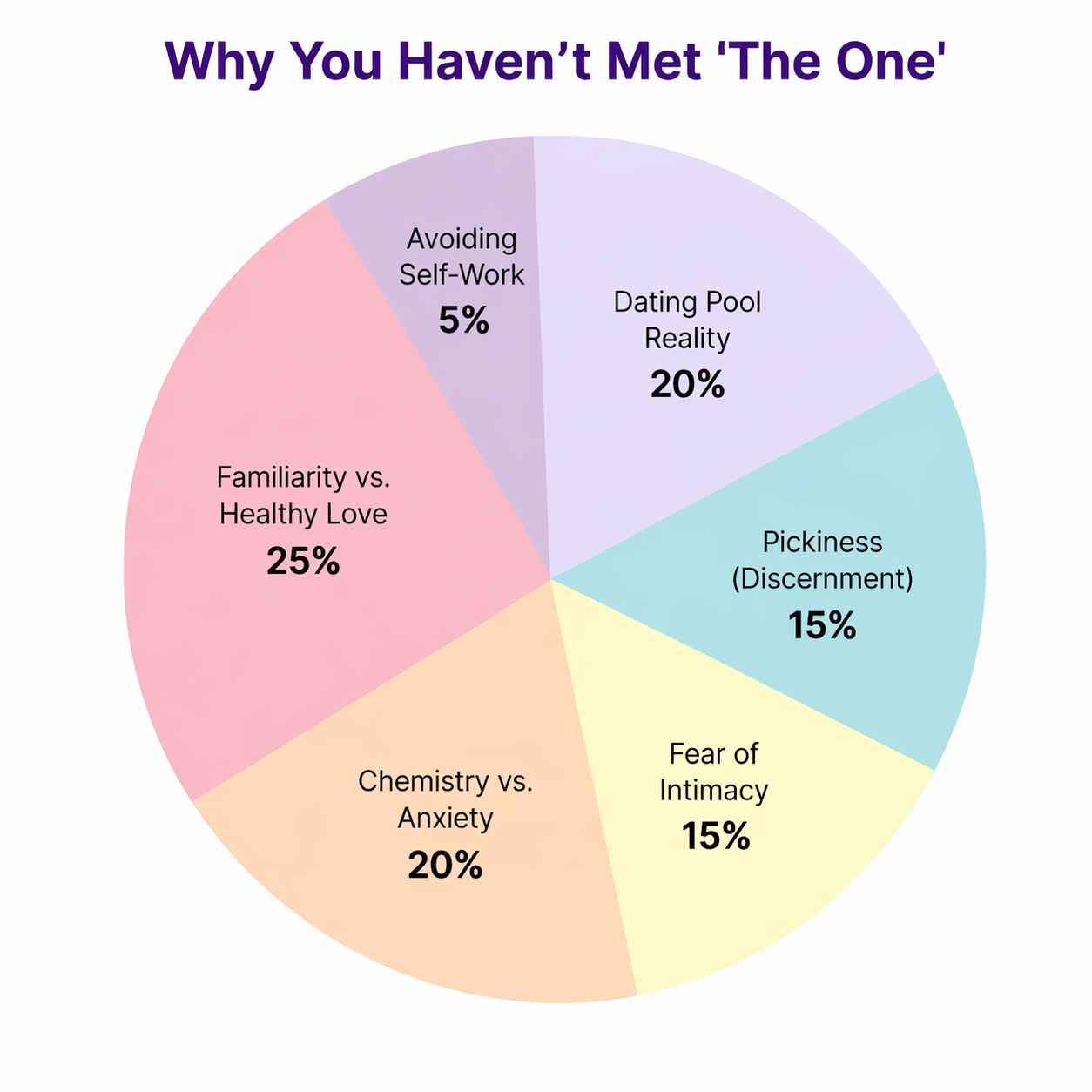
Familiarity vs. Healthy Love (25%)

Back in 2019, I dated someone for about three months. At the time, my most intense relationship had been with Gemini—it was passionate, magnetic, and unforgettable. So when I started seeing this new guy, I expected to feel the same spark. He was attractive, kind, and genuinely interested in me. On paper, he was everything I should have wanted.

But I didn’t feel it. To be honest, I thought he was… boring. I kept asking myself, Why don’t I like him as much as I should?

The turning point came during our first and only disagreement. Instead of shutting down or lashing out, he calmly told me how he felt. He didn’t just say, You upset me. He explained where the feeling came from, what insecurity it touched, and why it mattered. He was vulnerable. And for the first time, I couldn’t argue with someone’s feelings—I could only empathize.

Looking back, that moment changed everything. It taught me that what I thought was “boring” was actually peace. I wasn’t anxious, I wasn’t guessing, I wasn’t walking on eggshells. I was safe. That safety allowed emotional intimacy to grow in a way I’d never experienced before.

And it hit me: so many people don’t know how to do this. Instead of saying, Hey, when you did this, it hurt me. Here’s why, they’d rather blame, withdraw, or project. Vulnerability takes courage, but it also creates closeness.

That relationship didn’t last—he eventually moved to Texas—but to this day, it’s still one of the only times I’ve felt truly safe with a man. What I once called boring, I now recognize as the quiet foundation of healthy love.

Chemistry vs. Anxiety (20%)

For a long time, I confused my anxiety for attraction. With Gemini, I thought the butterflies in my stomach, the overthinking, and the constant daydreaming meant I was deeply in love. But really, it was his mixed messages that created that adrenaline rush. I wasn’t enjoying my life while dating him—I was hyper-focused on him. My energy went into questioning where we stood, reading into his actions, and trying to stabilize something that was never consistent.

That wasn’t love. It was anxiety.

When I finally dated someone who was transparent about what he wanted and how he felt, I realized the difference. Suddenly, I wasn’t consumed by the “what ifs.” I wasn’t glued to my phone waiting for a response. The butterflies were gone—but so was the anxiety. What I used to call passion was really just instability.

Here’s what I’ve come to believe: chemistry is real, and you can’t fake it. But chemistry alone isn’t enough. I can recognize it quickly now—sometimes in just a couple of weeks. The real question is: am I willing to sacrifice my peace for it?

Because here’s the truth—chemistry isn’t a one-time miracle. It doesn’t only happen with one person in a lifetime. After Gemini, I thought I’d never feel that intensity again. But when I met Aquarius, I did. The difference was that Aquarius pursued me with consistency and intention. That showed me the difference between chemistry that’s built on chaos and chemistry that’s grounded in effort and security.

Now I see it clearly: butterflies are not the standard. Peace is. And if someone gives me chemistry but not clarity, they’re not my person.

Fear of Intimacy and Being Seen (15%)

For some people, being seen is terrifying. When someone is emotionally available, their love can feel like “too much,” and it makes them pull back. I’ve watched this dynamic play out—but when I look at my own patterns, I realize that I’ve usually leaned into intimacy instead of running from it.

The real issue for me hasn’t been pulling away from men who were genuine. It’s been recognizing when their version of intimacy didn’t match mine.

Take Capricorn, for example. Within a couple of weeks, I noticed mismatches between what he said and what he showed me. He told me I was beautiful, smart, and a catch—he gave me all the compliments in the world. But compliments aren’t intimacy. They aren’t pursuit. They aren’t the same thing as building an emotional foundation with me.

What I needed was effort. I needed someone who didn’t just say he respected me but actually asked, What does respect look like to you? Because respect is subjective—it’s not one-size-fits-all. Without that kind of curiosity, his attention felt more physical than emotional. And physical connection, as much as it can feel good in the moment, is something I can have with almost anyone. Emotional intimacy is what makes it meaningful—and that was missing.

So even though I was “a catch” in his eyes, he wasn’t really trying to catch me. And that distinction mattered. Had we built a deeper foundation, I might have stayed longer. But without it, I wasn’t afraid of intimacy—I just wasn’t willing to settle for a relationship where intimacy was never the priority.

The Pickiness Factor (15%)

I used to believe people when they said I was “picky.” I even thought the same thing about one of my friends recently, until I realized that what looks like pickiness from the outside is often just discernment.

There’s a difference between rejecting people for shallow reasons and recognizing when someone simply doesn’t meet your needs. After my last relationship, I learned what it feels like to be pursued wholeheartedly. To be treated like family. To feel wanted, prioritized, and chosen. Once you’ve felt that, it’s hard to unsee it. You know what’s possible, and you’re not willing to settle for less.

That doesn’t mean I expect perfection. I know I’m not perfect either. I’m willing to adjust how I communicate, the tone I use, or the way I handle conflict if it helps a relationship grow. Those things don’t change who I am at my core. But what I won’t do is shrink myself to fit into someone else’s version of “the perfect woman.”

With Aquarius, that was the breaking point. I never tried to change his core values or who he was as a person. But he often wanted me to change mine — to be less emotional, less outspoken, less me. I wear my heart on my sleeve. I’m passionate. I’m expressive. That’s who I am. And if that’s “too much” for someone, then we’re simply not aligned.

Because here’s the truth: someone who truly loves you will never ask you to change who you are at your core. They’ll ask you to grow, to soften, to stretch — but not to abandon yourself.

So no, I’m not picky. I’m clear. I want a partner who sees me fully and loves me as I am, while encouraging me to become the best version of myself. Anything less isn’t love. It’s compromise at the cost of my identity. And I’m no longer willing to pay that price.

The Dating Pool Reality (20%)

Attachment research shows that in the general population:

  • ~50–55% of people are securely attached

  • ~20% are anxious-preoccupied

  • ~25% are avoidant or disorganized

That sounds promising at first glance — half secure! But many of those secure individuals are already partnered. Which means that in the single pool, the percentages shift: you’re statistically more likely to come across avoidant or unhealed attachment styles than truly secure ones.

That’s why dating after healing can feel discouraging. It’s not that your standards are “too high” — it’s that you’re filtering for what’s actually rare.

Avoiding Self-Work (5%)

Another huge reason people don’t find “the one” is simple: they refuse to do the inner work.

I saw this play out with Aquarius. Whenever I pointed out patterns in our relationship, instead of reflecting inward, he took it as an attack. There was no curiosity, no moment of, “Let me sit with that and see if it’s true.” Therapy wasn’t an option for him — not because he couldn’t access it, but because he didn’t believe he needed it.

But here’s the truth: if you’re the only one pointing out issues in a relationship, of course there’s going to be a bias. That’s why self-work matters — because without it, every partner you meet becomes “the problem,” instead of a mirror.

At the end of the day, love isn’t about finding someone flawless or perfectly healed. It’s about finding someone willing to look inward, to grow, and to meet you in the work of building something real. I’ve learned through every stage—chaos, butterflies, peace, mismatches, discernment—that the “one” isn’t just discovered, they’re co-created. And until both people are ready to face themselves with honesty, even the strongest chemistry or deepest attraction won’t last. I’d rather wait for that kind of partnership than lose myself trying to turn avoidance into intimacy.

Love is not about finding the perfect person, but about seeing an imperfect person perfectly.

Sam Keen

I’ve been in so many different places when it comes to love. I’ve been the woman chasing mixed signals, the one confusing chaos for passion, the one leaning into peace but calling it “boring,” and the one who finally raised her standards high enough that she could no longer settle. So when people say, “Why can’t I find the right

The Legacy We Inherited

I grew up in a home where emotions were not welcome — at least, not all of them. Anger was allowed. Anger made sense. But sadness? Vulnerability? Crying? That was met with confusion or disgust. If I cried, I was told to stop. If I showed sensitivity, I was made to feel like something was wrong with me. There was no space to ask why I felt what I did. There was just the expectation that I stop.

One moment I carry with me happened in third grade. I had left my homework on my desk at school — a simple mistake, but one that devastated me. When we got home and I realized it was missing, I panicked. I cried. I begged my mom to let me go back and get it. She looked at me and said, “Why are you crying? It’s not that big of a deal.” But to me, it was. I wasn’t crying because of the homework. I was crying because I felt like I had failed. Like I could have done better and didn’t. And instead of being comforted, I was dismissed. The only person who consoled me that day was my grandmother — the same woman my mom says never showed her affection growing up. But with us, her grandchildren, she had softened. She held me while I cried. She didn’t say much, but she was present. And in a house where feelings were often shut down, that presence meant everything.

Another memory comes from a few years later, when I was trying to learn English. It wasn’t easy — it wasn’t my first language, and I struggled with pronunciation and fluency. At the time, I was reading below grade level, and it made me feel small. Embarrassed. So I made a decision: I started checking out Harry Potter books from the library, along with the audio CDs. Every day after homework center, I would sit and listen to the CDs while reading along with the book, sometimes pausing to look up words or repeat sentences out loud. It was tedious and lonely, but it worked. Over time, I caught up — and then surpassed my grade level.

What I remember most, though, is how my mom would tell me, “You’re always reading. Go do something else.” She didn’t understand. To her, it was just another book. But to me, it was a language, a world, a fight to belong — a fight I was quietly winning.

I think about those moments now, as a mother, and I realize: I was never taught how to process emotion. I was taught how to suppress it. I was never taught how to reflect. I was taught how to perform. But even then, I was doing the best I could with what I had — and so was my mom. That doesn’t erase the hurt. But it helps me hold the truth with both hands: I can be grateful for what she gave me, and still grieve what I didn’t get.

Parenting While Reparenting Ourselves

The most humbling part of being a cycle breaker is realizing that your kids don’t just learn from what you teach — they learn from how you heal. My children are growing up in a world where emotional safety is prioritized. Where apologies are modeled. Where space is respected. Where crying isn’t shameful — it’s allowed. And yet, even in that, I still make mistakes. I still get overwhelmed. I still snap. But the difference now is: I come back. I apologize. I explain. And every time I do, I teach them that love doesn’t require perfection. It requires repair.

A few years ago, my daughter started feeling left out from her friend group. She had introduced two of her friends to each other, and the two of them began bonding more with each other than with her. She felt excluded, replaced. She was angry, hurt, and didn’t know what to do with those feelings. I asked her if she had told her friends how she felt, and she said no. So I told her a story — one that had happened to me not long before. I had introduced two of my friends, and they started hanging out and making plans without me. It stung. I didn’t say anything at first, but eventually I shared how I felt — gently, without blame. My friend validated me, apologized, and explained it hadn’t been intentional. That conversation meant so much, because it reminded me that naming our feelings gives people the chance to respond with care.

After hearing my story, my daughter talked to her friends. She told them how left out she had felt. And what she learned was exactly what I had learned: the exclusion wasn’t intentional. They just hadn’t realized. And after that, the dynamic shifted. They included her more. She felt seen. And I saw her grow in a way I didn’t know was possible at her age — not because she had all the answers, but because she had the language and the courage to try.

Then there was my son — just a few months ago. He was overwhelmed with homework, and I was overwhelmed too. I was cooking, cleaning, juggling a hundred things at once, and he kept saying, “I can’t do this without you.” I told him gently, “Please do what you can on your own, and I’ll help you as soon as I can.” He tried. But the overwhelm hit him too, and he stormed off, tears in his eyes. When I checked in on him, he looked at me and said, “Mom, right now I just need my space. Please give me my space.

I could’ve been hurt by that. I could’ve taken it as disrespect. But honestly? I was so proud. My son had just modeled something it took me years to learn: Self-Regulation. Boundaries. Emotional clarity. He didn’t argue. He didn’t yell. He asked for space, and when he came back, he was calm and ready to work. I told him how proud I was of him — not just for doing the homework, but for knowing himself. For asking for what he needed.

These are the moments that remind me why I keep doing this work — even when it’s lonely, even when it hurts. Because I may not have had this safety growing up… but I’m building it now. And my kids? They’re growing up inside of it.

The Pain of Watching Others Stay the Same

One of the hardest parts of healing is watching someone you love choose not to grow with you.

There’s someone from my past — I’ll call him Aquarius — who meant more to me than I think he ever realized. For a long time, he wasn’t just someone I loved — he was my best friend. My safe space. My sounding board. We could spend hours on the phone, talking about everything and nothing, and I felt seen in a way I rarely had. That kind of connection doesn’t happen often. And even after our relationship ended, I held onto that friendship — not because I was trying to go back, but because it had once meant something real to both of us.

Over the past year and a half, I’ve done so much internal work — not just for me, but also because I knew how I had hurt him. Even though my healing journey began long before we met, something about the way I showed up in that relationship made me want to grow deeper, faster, more intentionally. I had shame — for a long time. But eventually, I stopped running from it. I took accountability. I named it. I said the words out loud — not just to him, but to the people closest to me. And something lifted. The shame transformed into clarity. I could finally breathe.

So when Aquarius reopened the door earlier this year — when he shared a vulnerable moment, a sliver of hope — I responded with patience. I gave him space when he disappeared for weeks. I didn’t pressure him. I checked in gently. I knew he was overwhelmed with life, with work, with his own emotional weight. I tried to meet him where he was. And for a while, I thought we were reconnecting — not as lovers, but as friends. As two people who had once known each other’s hearts.

But then came the silence. The vague explanations. The mixed signals — like sending me a song filled with meaning and future hope, only to follow it with a cold declaration: I’m going to move on. 

I didn’t ask him to stay. I didn’t beg for love. What I asked for was clarity. A conversation. A shared goodbye that honored the depth of what we had.

Instead, I was met with defensiveness. Dismissiveness. He said I was asking too many questions. That I was prolonging the conversation. That I was annoying.

And it hurt. Because what he didn’t see — or maybe didn’t care to see — was that I was doing something I had never been able to do before: holding space for someone else’s process while staying regulated in my own. I wasn’t reactive. I wasn’t demanding. I was patient in a way I had never been when we were together.

And still, I was treated like a burden. As if compassion somehow made me clingy. As if seeking understanding was just another way of holding on.

He told me, “We can talk. But after this, I expect not to hear from you again.” And that broke something.

Because in the last year and a half, all I’ve done is grow into someone I wish I had been for him back then. I didn’t expect him to come back. But I hoped he’d see me clearly. I hoped the friendship could survive. I hoped the love — even if it wasn’t romantic — could evolve.

Instead, I was erased.

And that’s the pain of healing alone. You grow. You soften. You try again — with boundaries, with compassion, with care. And still, people treat you as if you haven’t changed. As if your growth is invisible. Or worse — inconvenient.

Empathy, Not Excuses

I used to ask myself, “Why did I have to go through all of this?” Why couldn’t I have been born into a healthy family, into secure attachments, into a home where crying wasn’t something to be shut down, but something to be comforted?

And for a long time, I didn’t have an answer. All I had was grief. But now, after doing this work, I’ve come to understand something: Empathy doesn’t excuse what happened. But it does help me carry it differently.

My mom wasn’t a villain. She wasn’t cruel. She was just a woman doing the best she could with what she had — and what she had wasn’t much. She didn’t grow up with access to therapy. She didn’t have mental health language or resources. In her world, you didn’t cry to be comforted — you cried in silence and kept moving. And if you talked about therapy, you weren’t “getting help.” You were “going crazy.” That’s the world she came from.

So no… I don’t blame her. That doesn’t mean it didn’t hurt. But I’ve let go of the resentment, because I know that hurt people don’t need more judgment — they need context. And my mom’s context was survival.

Still, I’ve seen her change — not for me, but in her own way, with time. I’ve watched her parent my younger brothers with a softer edge. I’ve seen her be affectionate with my children in ways she never was with me — hugging them, kissing them, celebrating them. And while it sometimes feels foreign to witness, I know that same awkwardness must have shown on her face when she saw her own mother hold me through tears — something she never got.

It’s strange. To grieve the mother you needed while watching her become that mother — just not for you. But that’s part of healing, too. Accepting that people can grow, even if it’s too late for them to repair what they did to you.

And honestly? I don’t think my mom will ever change in the ways I once hoped. She’s said herself — “I’m too old to change.” Maybe she is. Or maybe she’s just tired. But either way, I don’t try to force it anymore. I don’t try to make her understand my pain. I’ve accepted that she might never fully see it. And that’s okay — because I see it now. And I’ve made a decision she never had the chance to make: I’m breaking the cycle. 

Not because I’m better.

Not because I’m perfect.

But because I was born into a different time — with access to therapy, support, language, and tools that weren’t available to her. Because I want my children to live in a home where emotional safety isn’t an accident — it’s intentional.

And yes, I get overwhelmed. I make mistakes. But I take accountability. I apologize. I check in with my kids after I snap. I model the repair I never received.

Sometimes I think about the people around me — the ones who seem to have had easier starts. The ones who met their partners in their twenties, built secure lives, got married without the detours of trauma and chaos. And I wonder, why not me?

But then I remember: My path wasn’t meant to be smooth. It was meant to be transformational. Because some of us weren’t born into healthy families — we were born to create them.

The Paradox of Healing

Healing is supposed to connect you — to yourself, to others, to something bigger. But what no one tells you is that sometimes, the deeper you go into healing, the more lonely it becomes.

Because growth isn’t just about self-care and affirmations. It’s about facing the wreckage you’ve left behind — the people you’ve hurt, the shame you’ve carried, the things you did when you were still moving through life in survival mode. It’s about waking up one day and realizing: I can’t live like this anymore. I don’t want to keep hurting people.

That’s what pushed me to heal. Not pressure from others. Not some perfect rock-bottom moment. But the realization that my inability to sit with discomfort — to tolerate fear, to regulate my emotions — was hurting people I loved. And once I saw that clearly, I couldn’t unsee it.

One of my earliest turning points came from someone I call Gemini. He didn’t shame me. He didn’t attack me. He simply pointed out — with calm honesty — that some of my reactions were disproportionate to the situation. No one had ever said that to me before. I’d always been enabled. But something about the way he said it, with care but firmness, stayed with me. That moment sent me to therapy — and it changed the entire course of my life. I’ll always be grateful for it.

And then there was Aquarius. Someone I hurt — deeply. Someone who, even now, has walls up so high that not even my growth can reach him. Not even others can get through. And sometimes, that reality breaks me all over again. Because I know I shattered something in him — and even though I’ve changed, he may never see that version of me. He may always look at me through the lens of who I was back then. And I get that. I don’t blame him. But it still hurts.

Because I didn’t heal to show off. I didn’t grow to make anyone feel small. I did the work because the weight of my own actions crushed me. Because the shame sat in my chest like stone. Because I couldn’t live with the thought that I might hurt someone else the way I hurt him.

So I sat with it. For weeks, for months, for years. Through silence. Through rejection. Through moments where I wanted to reach out with desperation — but instead chose love. Chose patience. Chose presence. And still… some people never came back.

That’s the paradox. 

You do the work so you can love better — but the people you want to show that to the most might never see it. You come back with softness — but they still see the storm. You speak with grace — but they still hear echoes of your past self.

And even when you understand it… it still leaves a hollow space.

But here’s what I’ve come to believe: Healing doesn’t guarantee reconciliation. Growth doesn’t promise recognition. Change isn’t always witnessed by the people who inspired it.

And yet… you keep going.

Because at some point, healing stops being about being seen by others — and starts being about living with yourself. And if the people you once hurt can’t accept that new version of you, it’s not because you haven’t changed.

It’s because your growth became a mirror they weren’t ready to look into.

Healing Forward

Healing is not a straight line. It’s not a three-step checklist. It’s not linear, or glamorous, or always rewarded.

Sometimes healing means parenting your children in ways you never experienced. Sometimes it means apologizing to people who won’t forgive you. Sometimes it means forgiving people who never apologized. And sometimes, it means walking away — not because you want to — but because you know that staying would only recreate the pain you worked so hard to escape.

I used to think healing would feel like peace.

But now I know: Healing often feels like being misunderstood by the people you’ve changed for. Like mourning relationships that couldn’t survive your growth. Like watching others stay stuck — and still choosing not to join them.

But even in that loneliness… 

Even when it feels like no one sees you…

You see you. And that is enough.

Because healing isn’t just about breaking cycles. It’s about becoming the person you once needed — and offering that person to the world anyway, even if they don’t always know what to do with your love.

I walked alone not because no one loved me, but because I chose to love differently — to feel the ache, to hold the mirror, and become the mother, the friend, the home I once needed.

Faith

The Legacy We Inherited I grew up in a home where emotions were not welcome — at least, not all of them. Anger was allowed. Anger made sense. But sadness? Vulnerability? Crying? That was met with confusion or disgust. If I cried, I was told to stop. If I showed sensitivity, I was made to feel like something was wrong

There’s something about Huda from Love Island that resonates deeply with me. Some people see her as aggressive, defensive, bossy. I see a survivor. A woman who was once a little girl no one believed. A girl whose own parent violated her. Who was bullied, silenced, and humiliated. And who—like me—had to learn how to survive in a world that kept trying to erase her truth.

Huda shared that she was sexually abused as a child, and to this day, her family still doesn’t believe her. She was bullied in middle school, and by high school, she decided it would never happen again. She developed armor—boldness, assertiveness, even aggression—because it worked. It protected her. And now, as a 22-year-old woman, that armor is still on. It may not always be healthy, but it helped her survive. And I get that more than most people know.

I, too, was sexually abused as a child. I was bullied in high school for being in foster care. People didn’t ask questions—they just judged, gossiped, and made assumptions. I felt completely alone. And like Huda, I survived because I had to. But surviving isn’t the same as healing.

I was in a toxic relationship in my early 20s, and later, when I finally dated someone who didn’t enable my behavior, everything I had buried came to the surface. He cared about me enough to call me out—and that was new. That relationship led me to therapy, where I was diagnosed with Borderline Personality Disorder. For years, I went weekly. I tried to rewire everything my trauma had conditioned me to believe and feel. Not because I wanted to be “fixed,” but because I didn’t want my kids to inherit my pain.

People criticize Huda for “not taking accountability.” But I see someone trying to explain herself—trying to be understood, not excused. There’s a difference. When you’ve been a victim for so long, it’s hard to let go of that lens. You don’t immediately start believing life is happening for you instead of to you. It takes years of work. I know—because it took me nearly three decades to get there.

Even with all that growth, I still struggled in relationships. Not everyone does the work. Not everyone knows how to take feedback without seeing it as criticism. I’d communicate my needs—something I learned in therapy—and it would still spiral into conflict. All because they hadn’t done the same inner work.

I remember one relationship where all I asked for was space during arguments. Not to abandon, not to punish—but just to regulate. I even reassured him that I loved him, that I wasn’t walking away. But he couldn’t handle it. Because he had been abandoned in the past. And because I didn’t hold that boundary firm, the pattern kept repeating. Later, when he needed space, I was expected to honor it. But when I asked for the same, it was seen as rejection. The hypocrisy hurt more than the argument ever could.

Eventually, I did meet someone different. Someone who had been to therapy. Someone who, when he felt insecure about my past friendship with another man, didn’t lash out—he looked inward. He shared how his ex had betrayed him. He took responsibility for his triggers instead of blaming me. And in that moment, I realized what emotional maturity looks like. It looks like reflection. It looks like growth. It looks like trust.

That’s what people need to understand about Huda. There are two kinds of people watching her. One group sees her and feels compassion—not because they excuse her behavior, but because they’ve been her. They’ve survived and healed, and they believe she can too. And then there are those who hate her—not because of who she is, but because she reminds them of a part of themselves they’ve buried. A part they haven’t healed. And instead of reflecting, they project. They ridicule. They dehumanize.

But here’s the thing—healing never comes from shame. It comes from safety. From being seen. From being believed.

At 28, I still acted like Huda sometimes. I was just lucky I wasn’t on national television while doing it. And I still felt isolated. Misunderstood. Judged. So when I see her trying—explaining herself, holding back tears, trying to advocate for her truth—I don’t see a villain. I see someone fighting for a voice that was taken too young.

I’m 33 now. And I’ve done the work. But I still see myself in her. I still believe in her. And I hope others do too.

Because if we’re going to claim we care about mental health, then we need to stop picking and choosing who deserves compassion. Accountability and empathy can coexist. You can call someone in without tearing them down. You can want better for someone without condemning who they’ve been.

Healing is messy. Growth is not linear. And trauma responses don’t vanish just because the cameras are rolling.

So next time you see someone like Huda—on TV, online, or even in your own life—pause before you judge. Ask yourself if what you’re reacting to is really about them… or about something you haven’t faced within yourself.

Because true healing starts with compassion. And we could all use a little more of that.

Your trauma is not your fault, but your healing is your responsibility.

Unknown

There’s something about Huda from Love Island that resonates deeply with me. Some people see her as aggressive, defensive, bossy. I see a survivor. A woman who was once a little girl no one believed. A girl whose own parent violated her. Who was bullied, silenced, and humiliated. And who—like me—had to learn how to survive in a world that

I used to pray that he’d come back. I thought that was faith—believing that love could still find its way home. But over time, my prayers began to change.

Now I pray that he finds peace. That he heals. That he meets someone capable of loving him in the ways he can truly receive.

Because real love doesn’t cling. It releases. It trusts. It lets God be God.

For so long, I thought I knew better than God. I held on so tightly to the story I wrote in my mind—that if I just stayed soft enough, patient enough, worthy enough, it would all work out the way I hoped. But I’ve come to learn that even the deepest love, if it’s not aligned with God’s will, is not meant to stay.

And if the only reason this person came into my life was to ignite this level of growth—to break me open and help me become someone I never imagined—I still thank God for it. Even the ache. Even the unanswered prayers.

Because through it all, I found something more enduring than romance. I found reverence. I found surrender. I found myself.

Lately, I’ve been thinking about Judas. Not just the traitor we were taught to condemn, but the man who followed Jesus, witnessed miracles, and still couldn’t fully see.

He wanted more proof. More control. Maybe even more of Jesus than Jesus was ready to reveal. But maybe Judas’s betrayal wasn’t just about forcing something sacred into human timing—it was also about fleeing from the very thing he couldn’t bear to trust. Because betrayal doesn’t always come from hatred. Sometimes it comes from fear. The fear of surrendering to something greater than us. The fear of stepping into love that asks us to risk being fully seen.

Some people try to control love to make it feel safer. Others run from love because it already feels too powerful to hold. And I think both were true of Judas. Just as both have been true of me. And maybe even the person I loved. Because we’re taught that love doesn’t conquer all. That love is too fragile. Too risky. Too naive.

But maybe what breaks us isn’t love itself—it’s the fear that we’ll never be enough to stay inside it.

But even in that betrayal, Jesus didn’t shame him. He didn’t lash out. He didn’t call him enemy. He called him friend. He surrendered, even knowing how it would all unfold. Not my will, but Yours be done.

That’s the kind of surrender I’m learning now.

Because sometimes, like Judas, we try to force something that was never ours to control. We think if we push hard enough, cling long enough, prove ourselves enough, we’ll make love behave the way we want it to.

But that’s not faith. That’s fear dressed up as determination. Or avoidance dressed up as detachment.

So I’ve stopped asking God to bring him back. I’ve stopped trying to rewrite a story that was never mine to author. I’ve stopped confusing the pain of letting go with the idea that I’m unworthy.

Now, I ask God for peace. I ask for clarity. I ask for the strength to accept what is, not what I imagined.

Because real love says: I want the best for you—even if the best isn’t me. And real faith says: I trust God’s plan—even when it breaks my heart.

Maybe I’ll never get the ending I wanted. But I got something greater. I got transformation. I got freedom. And I got closer to God.

So if he never comes back around… I’ve accepted it. Because sometimes, the people who hurt us the most were never meant to stay. They were meant to awaken us. And maybe, in some mysterious way… that was the miracle all along.

Sometimes what breaks your heart is the very thing that brings you back to God. We don’t always get the love we want, but we always get the healing we need.

Mia Segura

I used to pray that he’d come back. I thought that was faith—believing that love could still find its way home. But over time, my prayers began to change. Now I pray that he finds peace. That he heals. That he meets someone capable of loving him in the ways he can truly receive. Because real love doesn’t cling. It

There was a time when I thought love meant never letting go—especially when I was the one who had caused the hurt.

Two years ago, I loved someone deeply. And at first, I believed I loved him. But when I look back now, I realize what I really fell in love with was how he made me feel. Safe. Seen. Regulated. Worthy.

Around him, I softened. I was more affectionate, more grounded. I felt like a better mother, a better person. He brought out this nurturing, gentle version of me that I’d never fully felt safe enough to express before. It was like I’d finally unlocked a part of myself that had been waiting all along to be held.

And I think I also fell in love with the fantasy. Not the potential of who he could become—but the vivid future I imagined for us. I fantasized about our life together, living under the same roof, having a routine, building something permanent. I created that entire world in my mind within the first month. But a month isn’t enough to truly know someone. I see that now. When you’ve grown up with abandonment or emotional chaos, even the possibility of stability can feel like destiny.

We broke up. We didn’t speak for months. But somehow, we found ourselves back in each other’s orbit—again and again. For nearly two years, we lived in this cycle: we’d get close, then he’d pull away. Tentative reconnection followed by silence. Hope tangled with distance. And through it all, I stayed.

I didn’t stay to beg for love. I stayed to show him the growth. Not in the way that screams take me back—but in the quiet, steady way that says, I’ve changed, and I hope you can see that.

Because I knew I had broken something in him once. And that haunted me. I didn’t just want his forgiveness—I wanted him to know that I took the pain I caused, and I transformed it.

I alchemized the shame. I used the guilt. I let it refine me.

When I was sitting in anxiety, I didn’t run from it like I used to. I stayed. I reminded myself: others have felt this pain because of me—and now I understand it. That awareness didn’t destroy me. It deepened me. It softened me. It made me more compassionate.

And just when I thought we might finally have a chance at clarity—when I asked him what he wanted—he gave me hope. He didn’t walk away. He left the door open.

But within an hour, when I asked for clear confirmation, he ended it.

That moment broke something in me. Not because of the ending—but because he had a chance to be honest with me the first time and wasn’t. It felt like a betrayal. And in that betrayal, I lashed out—not because I wanted to hurt him, but because I felt devastated that, after all that time and all that healing, he still couldn’t be honest with me.

But the most surprising part? I didn’t lose myself in that pain.

I realized that I can love unconditionally… and it won’t be the end of me. I can sit in vulnerability without becoming unhinged. I can care deeply, even when it’s not returned, and still walk away with my dignity.

Because the version of me now? She’s no longer loving to be loved back. She’s loving because it’s who she is.

But there’s a difference between unconditional love… and unconditional access. And that’s what I finally learned.

If someone can’t recognize what they have in front of them… if they don’t want to meet me where I am emotionally… if they treat me like a placeholder or a maybe… I’m no longer going to spend my life proving I’m worthy.

Because I am worthy. And not because someone chooses me. But because I chose me.

So yes… I still love him. But that love is no longer about filling a void. That void was never his to fill. It was mine.

I can be changed by what happens to me. But I refuse to be reduced by it.

Maya Angelou

There was a time when I thought love meant never letting go—especially when I was the one who had caused the hurt. Two years ago, I loved someone deeply. And at first, I believed I loved him. But when I look back now, I realize what I really fell in love with was how he made me feel. Safe. Seen.

You were the first person who ever told me something I’d never heard before:

“That reaction doesn’t match what’s actually happening.”

As simple as it was, it hit me in a way nothing else had. Not because it hurt—but because it was true. And no one had ever said it to me with that much calm, that much clarity. You weren’t trying to criticize me… you were just being honest. And that honesty stayed with me. A month after that moment, I walked into therapy for the first time and received a diagnosis that changed everything. You didn’t know it, but you started that journey for me.

We were never easy. Our relationship stretched across nearly three years—on and off, full of restarts and resets. You were avoidant. I was anxious. You pulled back when I needed closeness. I chased when you needed space. Our emotional instincts clashed constantly. But somehow, through it all, we kept trying.

Back then, I thought space meant rejection. I thought if someone stepped away, it meant they didn’t care. But you showed me that space can be love too. That giving someone room doesn’t mean giving up on them. It took me a long time to understand that. But because of you, I do now.

There were so many moments of miscommunication. So many times we got it wrong. But there were also moments that were so beautiful, so pure, they still live in me.

Lake Tahoe was one of those moments. You took me skiing for the first time, and you were so patient. You spent hours teaching me. You never got frustrated, even when I yelped my way down a bunny hill that felt like Mount Everest. And when the ski boots left blisters on my legs, you didn’t hesitate—you went to get the car, just so I wouldn’t have to walk.

I sat there, in the passenger seat, looking at the snow-covered slopes, pulling off my boots… and I cried. Not because I was in pain. But because in that moment, I felt completely safe. Cared for. Protected. I had never felt that kind of gentle love before. Not like that. And I don’t think you even realized what you were giving me.

We had our highs—and they were some of the highest I’ve ever had. And we had our lows, too—just as deep. We both made mistakes. Neither of us was perfect. But what I loved about you was this: when things got hard, you didn’t run. You stayed. You tried. And I saw that. I felt that.

There’s something you once said to me in a text that still echoes in my heart:

“I’ve been through good and bad times with you recently. There wasn’t a word we said like ‘I love you’—but we still worked through them. And when things have been good, we go through that. That’s special and important to me, whether we say ‘I love you’ or not, because we’re both choosing to work on things together.”

That hit me in a way I didn’t fully understand until now. Because it showed me what I value more than anything: not perfection… but partnership. The willingness to stay. To work through the hard things together. You did that. And that memory has shaped what I know I need in love—someone who chooses me, even when it’s hard.

You had other options. People who were easier, quieter, maybe more stable. People who enabled you or didn’t ask for much. But you still gave me a chance. You made a commitment to try. And in a world where people walk away so easily, you stayed long enough to see both my light and my shadow. You gave me that gift.

There’s a song that always makes me think of you—Lifetime by Justin Bieber.

“Some people come in your life for a reason, others they come in your life for a season… maybe you are a lifetime.”

I always thought you were my twin flame. You woke up parts of me that no one else had ever touched. There was something in the way we reflected each other—our wounds, our patterns, our strengths—that felt otherworldly. For the longest time, I believed that maybe, eventually, we’d find our way back. That time would do the healing and bring us full circle.

But with time, I realized: maybe we weren’t meant to be together forever. Maybe, as twin flames, our purpose was to awaken each other. To mirror what needed healing. To help each other evolve—even if the journey hurt.

That’s why it was so tumultuous. That’s why it was so hard to let go.

And that’s why, once I accepted it, I felt peace.

I don’t think I’ll ever have the words to express how deeply you helped me. You didn’t just challenge me—you transformed me. Spiritually. Emotionally. Personally.

And it wasn’t just the serious stuff. I still remember us dressing up as Joe and Love for Halloween. At the time, it felt funny, ironic. But now I look back and realize how accurate it was. Because like them, our love was all-consuming. Passionate. Messy. We loved each other fiercely… but sometimes in ways that reflected our unhealed parts. It wasn’t toxic. But it was intense. Unfiltered. Raw. We enabled each other’s patterns sometimes, even while trying to heal them. And somehow, we kept coming back, hoping love would be enough.

I hope you’ve found, or are finding, the kind of love you deserve. The kind that sees your whole heart, holds space for your silence, and chooses you every day without fear. You made me open my eyes to what love could look like when someone really shows up. And even though it didn’t last, it was real. You were real.

Thank you for showing me a love that was patient. A love that was real. A love that wasn’t forever, but still meant everything.

Even if it didn’t last forever… it changed me forever.

Some souls aren’t meant to stay forever… they’re meant to shake you awake, break you open, and leave you changed.

Unknown

You were the first person who ever told me something I’d never heard before: “That reaction doesn’t match what’s actually happening.” As simple as it was, it hit me in a way nothing else had. Not because it hurt—but because it was true. And no one had ever said it to me with that much calm, that much clarity. You

There are some people who enter your life and change everything. That’s what it felt like with you. I wasn’t expecting to meet someone that night, especially not someone who would stay with me—in memory, in heartbreak, in growth—the way you have. It felt like the world shifted just enough to let us cross paths. You approached me at a bar I almost didn’t go to, in a city neither of us lived in, and somehow, it felt like fate. From the moment we met, you had this calm energy, this confidence, this charm that was hard to look away from. And when you looked at me, really looked at me, it terrified me. Because somewhere deep down, I didn’t believe I deserved it.

That night was magic. Brunch the next morning, the way we talked and laughed like old friends, the time that disappeared between us—it was the best date I’ve ever had. Nothing has ever come close. I still remember everything: the food, the drinks, the way I didn’t want it to end. I wanted to ask you to stay longer, but I didn’t want to seem needy, so I let you go. Then came the baseball game, more bars, more conversation, and finally, that night in the hotel. It felt like a fantasy. And maybe it was. Because at that point, it was still easy to choose each other. The hard parts hadn’t come yet. The trauma hadn’t surfaced. The wounds hadn’t opened. We hadn’t yet learned how deeply we were capable of hurting each other.

I struggled to believe that someone like you could truly choose me. I questioned it from the start, even when everything was going well. My insecurities made me doubt your intentions, your faithfulness, your sincerity. I thought, why me? Out of everyone you could have had—why would you want me? And those thoughts didn’t just live quietly in the background. They showed up in how I treated you, how I communicated, how I pulled away just enough to protect myself while also hoping you’d fight for me. I know I caused pain. I lied. I acted out of fear. I overreached, and I crossed boundaries I wish I hadn’t. And for a long time, I carried shame for what I did to you. I thought it was my job to heal you because I had broken something in you. That wasn’t the first time I felt that way in a relationship, but it was the first time it broke me to try.

So I punished myself. I gave everything I had, trying to make up for what I had done. I overcompensated. I lit myself on fire to keep you warm. And still, you pulled away. Not all at once. You didn’t walk out with a goodbye. Instead, you stayed in the grey. You left without leaving. You led me on—not just once, but again and again. Every time you were drinking or feeling vulnerable, you’d reach out, say something tender, send a song, drop hints that made me think there was still hope for us. But when the morning came, you’d take it all back. You’d ghost me. You’d go cold. You’d say you couldn’t do this, that you were exhausted. And it confused the hell out of me.

You told me we didn’t work, but then you’d leave the door cracked open just enough for me to stay. You didn’t give me clarity—you gave me false hope. And every time I tried to address it, you brushed it off. You said you “realized it too late,” but that’s not true. I told you a year before what was happening. I named the patterns. I asked for clarity, for honesty, for accountability. You just didn’t want to see it. Or maybe you weren’t ready to. And when I asked for closure, you told me you were too emotionally exhausted to even try. But we hadn’t argued. We hadn’t fought. That exhaustion wasn’t from me—but you let me carry it anyway.

I needed more than vague gestures. I needed you to be clear. And you weren’t. You told me you made your choice, but then you sent me a song. You said it wasn’t going to work, but you kept showing up in ways that made it impossible for me to move on. If you had already let me go, you shouldn’t have kept pulling me back. That wasn’t love. That was fear. That was comfort. That was you not wanting to be alone, while making sure I was still tethered to you just enough to not walk away.

But I finally am. I’m not waiting anymore. I’m not hoping you’ll wake up one day and realize what we could have been. I’ve accepted that you didn’t choose me—and I respect that. But I also know that love isn’t just about fate. It’s about free will. It’s about choosing each other, even when it’s hard, even when it’s uncomfortable, even when the past haunts you. And you didn’t choose me. Not really. Not when it mattered.

Still, I want you to know this: you taught me something. You taught me how to love unconditionally. You showed me what it feels like to be fully present with someone, even if only for a short time. And you helped me realize that I am capable of deep love—messy, flawed, real love. I just didn’t know how to hold it yet. And now, I do. So thank you. For the lesson. For the magic. For the pain that pushed me into growth.

Maybe in another lifetime, we get it right. Maybe we choose each other with the same courage we had that first night, before the fear and doubt and damage took over. But in this life, I’m choosing peace. I’m choosing to let you go—with softness, not bitterness. With clarity, not confusion. With love, not longing.

You’ll always have a piece of me.

Love doesn’t survive on fate alone—it requires the courage to choose each other, even when it’s no longer easy.

Mia Segura

There are some people who enter your life and change everything. That’s what it felt like with you. I wasn’t expecting to meet someone that night, especially not someone who would stay with me—in memory, in heartbreak, in growth—the way you have. It felt like the world shifted just enough to let us cross paths. You approached me at a